
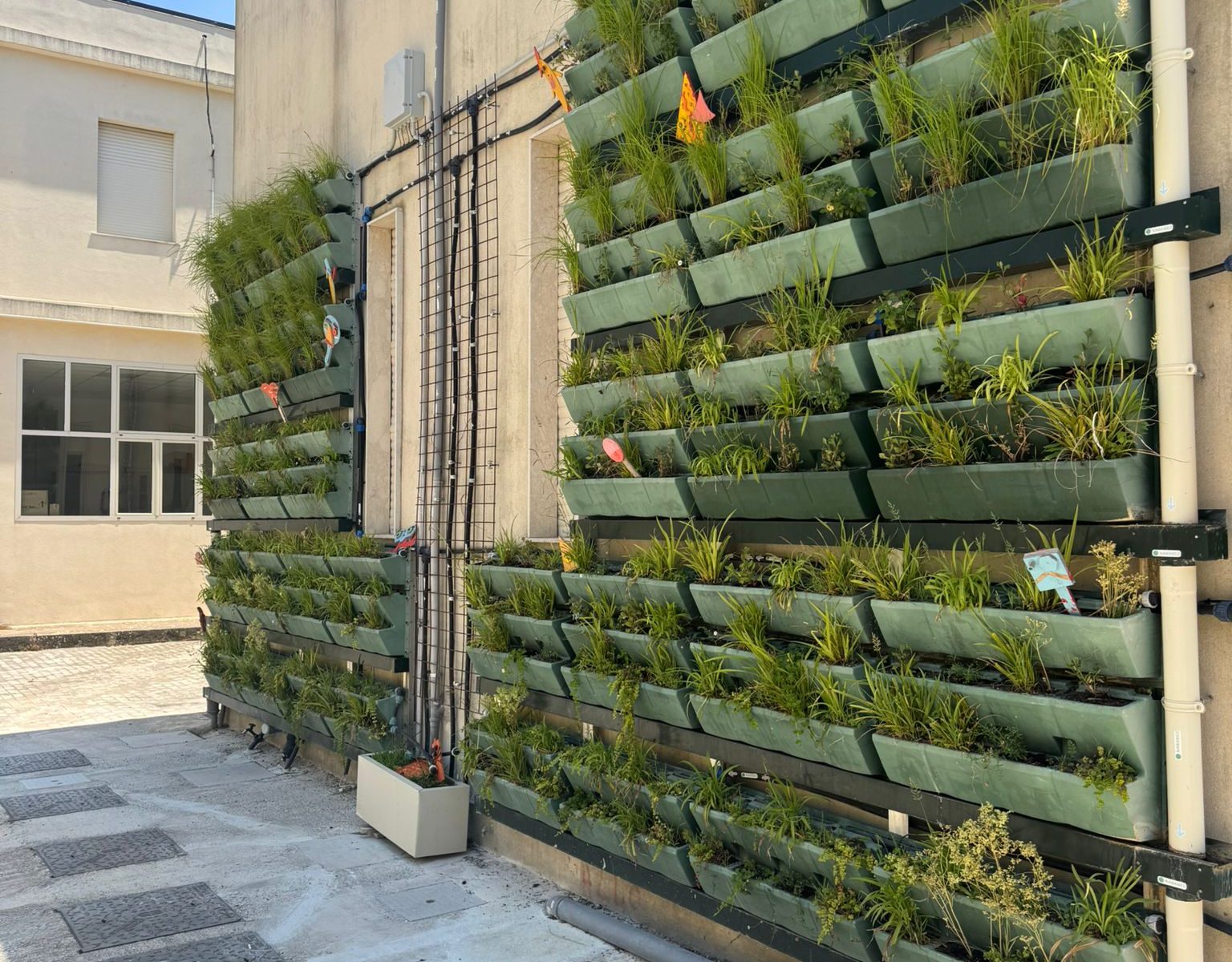
Heatwaves, extreme droughts, sudden downpours on impervious roads: Mediterranean cities are on the front line of the climate crisis. The European URWAN project – Urban Regenerative Water Avant-garde(N) – co-funded by the Interreg Euro-MED programme and coordinated by ANCI Lazio with eight partners from six countries, demonstrate that integrating Nature-based Solutions into urban regeneration is possible, replicable and measurable. Ferla was one of the five pilot cities, alongside Rome, Cuba (Portugal), Ptuj (Slovenia) and Sarajevo.
URWAN leaves behind a legacy in the form of a package of practical tools, the Enabler Pack, which provides an integrated framework of resources useful for implementing NbS. Among these tools is the NbS Catalogue, which can be downloaded free of charge from the project website in several languages. The Catalogue classifies NbS according to water management – WATER SNOB solutions, supplied by the drinking water network, and WATER SMART solutions, designed to use alternative sources – and helps users quickly identify which solution is best suited to the problem at hand. The Checklist, aligned with IUCN standards, provides step-by-step guidance on planning, risk management, financing and integration into local policies.
The Roadmap summarises the approach tested in the pilot cities, from local assessment to monitoring, and is accompanied by a training kit and co-design tools that have also been trialled in Ferla. It is designed primarily for small and medium-sized local authorities with limited technical and financial capacity, because green spaces are most lacking precisely where resources are scarcest.
The project has also delivered tangible results: in Rome, where a state school has been transformed into an open-air urban laboratory featuring green and blue infrastructure, water collection and reuse, and soil de-impermeabilisation; and in Cuba, in the Alentejo region, where rainwater and wastewater are treated and recirculated. Different contexts, contrasting problems – too much water or too little – and the same underlying principle, the very one that has guided Ferla’s work for years: working with nature, not against it.